Thursday, October 30, 2014

Charline von Heyl Etching

Charline von Heyl working on her prints in the historic Crown Point studio, San Francisco


Video by Crown Point Press, Published 27 October 2014.

Dust on a White Shirt (Evil Eye), 2014
$3,500
Dust on a White Shirt (Stripes), 2014
$3,500
The next item on Charline von Heyl’s agenda is a focus on her print work, at Crown Point Press. On the West coast, her new prints make their debut at the San Francisco gallery space, while days later a selection make their way to the East coast for the esteemed IFPDA Print Fair in New York. 

via Artsy

Wednesday, October 15, 2014

Angela Bulloch & Rolls Royce: A Brief Overview


The Rich Artistic History of Rolls-Royce Motorcars

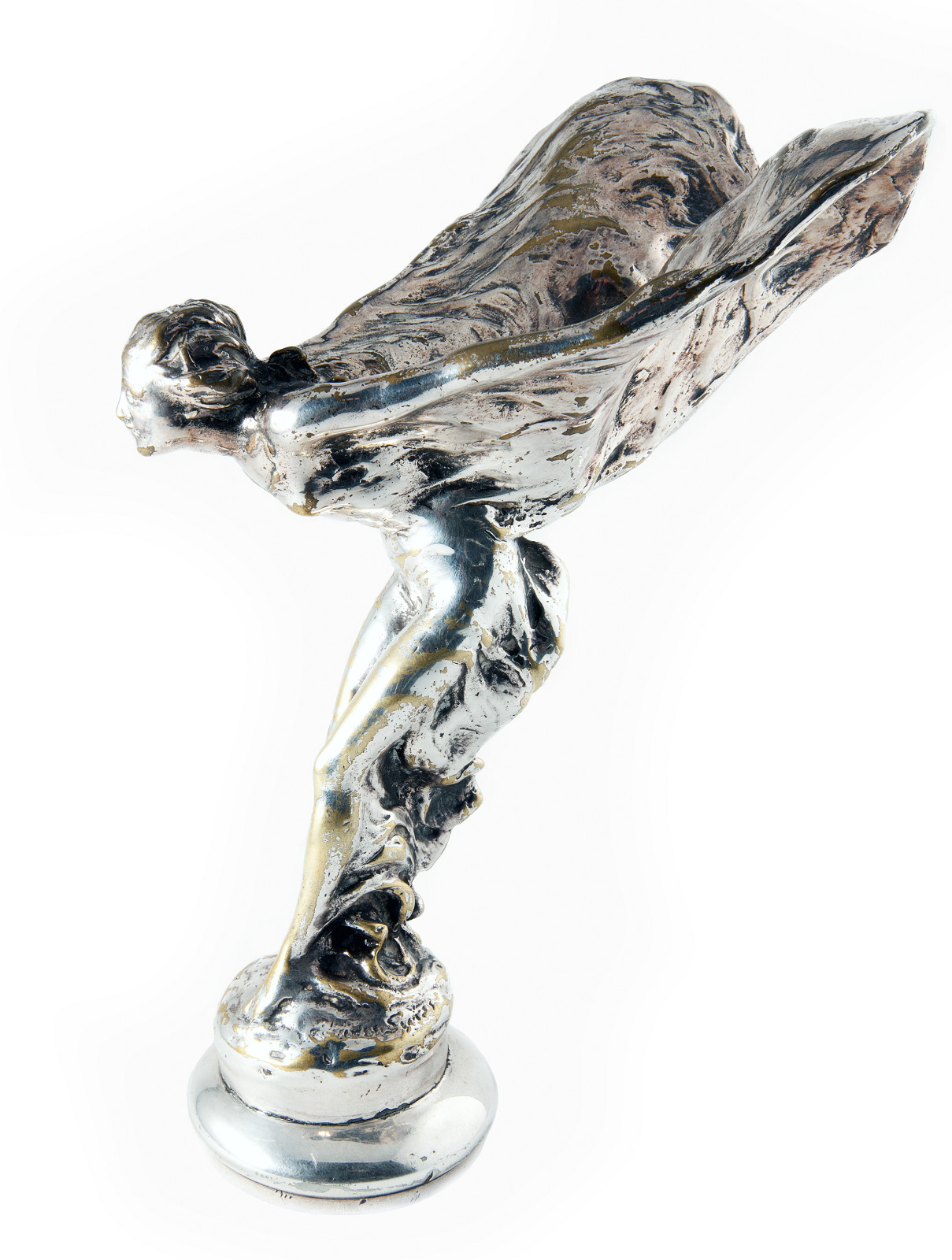
Rolls-Royce is perhaps aware that a few of their customers are slightly 'eccentric.' The cars have been a subject of interest for artists and collectors for more than 100 years. Rolls-Royce Limited was created over a famous lunch in May 1904. Henry Royce, a successful engineer, struck a deal with Charles Rolls, owner of one of the first car dealerships. The ensuing series of two, three, four and six cylinder cars broke the mould for engineering and craftsmanship. The Silver Ghost, launched in 1907, was a car of legendary smoothness that completed a 14,371 mile virtually non-stop run, creating 'the best car in the world' legend (2). The Spirit of Ecstasy, also called "Silver Lady" or "Flying Lady", was designed by English sculptor Charles Robinson Sykes and carries with it a story about a secret passion between John Walter Edward Douglas-Scott-Montagu, (second Baron Montagu of Beaulieu after 1905, a pioneer of the automobile movement, and editor of The Car Illustrated magazine from 1902) and the model for the emblem, Eleanor Velasco Thornton, Montagu's secretary.
Sykes, a graduate of London's Royal College of Art,  originally crafted a figurine of her in fluttering robes, having placed one forefinger against her lips - to symbolize the secret of their love affair. The figurine was consequently named "The Whisper" and is on display at the National Motor Museum in Beaulieu along with other Spirit of Ecstasy figurines. Only three or four castings were ever made, and only two are believed to have survived.
"The Whisper"


 Rolls-Royce became later concerned that some owners were affixing "inappropriate" ornaments to their cars. Claude Johnson, then managing director of Rolls-Royce Motor Cars, was asked to see to the commissioning of something more suitably dignified and graceful. Sykes' brief from Claude Johnson had been to evoke the spirit of mythical beauty, Nike, whose graceful image was admired in The Louvre. In 1911, Sykes chose to modify The Whisper into a version similar to today's "Spirit of Ecstasy" - "A graceful little goddess, the Spirit of Ecstasy, who has selected road travel as her supreme delight and alighted on the prow of a Rolls-Royce motor car to revel in the freshness of the air and the musical sound of her fluttering draperies."Some critics and fans of the Rolls Royce have given The Spirit of Ecstasy the dubious nickname "Ellie in her Nightie", suggesting Eleanor's influence as Sykes' muse. "(3)
"Nike of Samothrace"


"The Spirit of Ecstasy"
 
Rolls-Royce Commissions Turner Prize Nominee Angela Bulloch’s Installation
Angela Bulloch with her 'Cipher of L' installation, the dimensions of which are identical to a Rolls-Royce Phantom. Photo courtesy of http://uk.blouinartinfo.com.

Berlin-based Angela Bulloch's sculpture of flashing ‘pixel boxes’ lights up the Mayfair showroom of Rolls-Royce for the duration of Frieze London, 2014. This one-off piece has the same dimensions, and a similar level of craftsmanship, as a Rolls-Royce Phantom. Bulloch went to the Rolls-Royce workshop in Goodwood to seek inspiration, and was ‘impressed by the technology and quality of leatherwork and veneers that go into the making of all their cars’. Using LEDS for the first time, she adds: ‘The light programme that runs through my 'Cipher of L' piece uses a range of secret colours usually found on the exterior of Rolls-Royce's cars and the work will have a puzzling pattern that nearly never repeats.' (1)

“The Ideological Antecedents of the Rolls-Royce Radiator” (1962) by Erwin Panofsky discusses the origins of English architectural and artistic styles. He begins the essay referencing the English penchant for gardens, as seen in the so-called “Garden Revolution” of the second decade of the 18th century. This revolution marked the replacement of the Italo-French garden of the preceding era with what the “English Garden.” The English Garden rejected the formal style of gardening, epitomized by the gardens of Le Nôtre Versailles. These gardens "had proudly imposed upon the infinity and irregularity of nature the finiteness and order of a little universe conceived by man—a universe cut out of (and off from) the great outdoors and rationally organized into a geometrical pattern of avenues suitable for the stately progress of horsemen...carefully clipped into stereometrical shapes, “mazes” which pose neat problems in topology, and bodies of water disciplined to the regular contours of basins and canals..." (4) 

Panofsky cites Alexander Pope's "Moral Essays" (1731-35), which states: "Treat the Goddess [Nature] like a modest Fair / Nor overdress nor leave her wholly bare." (5)

1. "As Frieze fever takes over London, we preview the best satellite exhibitions around town" O'Kelly, Emma. Wallpaper magazine online edition. October 10, 2014.
http://www.wallpaper.com/art/as-frieze-fever-takes-over-london-we-preview-the-best-satellite-exhibitions-around-town/8083#FsjC6bYVwi3Js8lq.99)
2. "The Beginning," http://www.rolls-roycemotorcars.com/history/
3. "State Master Encyclopedia: The Spirit of Ecstasy," http://www.statemaster.com/encyclopedia/Spirit-of-Ecstasy. Accessed 11 October, 2014.
4. Panofsky, Erwin. “The Ideological Antecedents of the Rolls-Royce Radiator,” Proceedings of the American Philiosophical Society, Vol. 107, No. 4, August 1963. JSTOR.org, Accessed 11 October 2014.
5. Pope, Alexander. "Moral Essays," 1731-35. Ian Gordon. "Moral Essays." The Literary Encyclopedia. 24 Jan. 2002. Accessed 11 October 2014.<http://www.litencyc.com/php/sworks.php?rec=true&UID=3487

Friday, September 19, 2014

COSMOSCOW 2015 to feature work by Rirkrit Tiravanija

September 16 - MOSCOW - Dasha Zhukova announced that the Rem Koolhaas-designed new home for the Garage Museum of Contemporary Art, which she founded in 2008, will finally open its doors in June 2015. The space consists mostly of a heavily renovated version of a once-famous, now-dilapidated Soviet-era fine dining restaurant in Gorky Park, not too far from their current location, which is in the name part of town. Plans were first released back in 2012, so this has been a long time coming.

The Garage squad out in Moscow, which includes director Anton Belov and chief curator Kate Fowle in addition to Ms. Zhukova and Mr. Koolhaas, also rolled out the programming schedule for 2015. The initial slate of shows—spread throughout five exhibitions spaces in the 58,000-square-foot compound, which also sports an auditorium, a cafe, a screening room and a bookshop—will include a project by Rirkrit Tiravanija.


 Anton Belov, Rem Koolhaas, Dasha Zhukova, Kate Fowle. (Photo courtesy Garage)
A Rem Koolhaas rendering of The Garage Museum of Contemporary Art, set to open June 2015 
(Photo courtesy blouinartinfo.com)


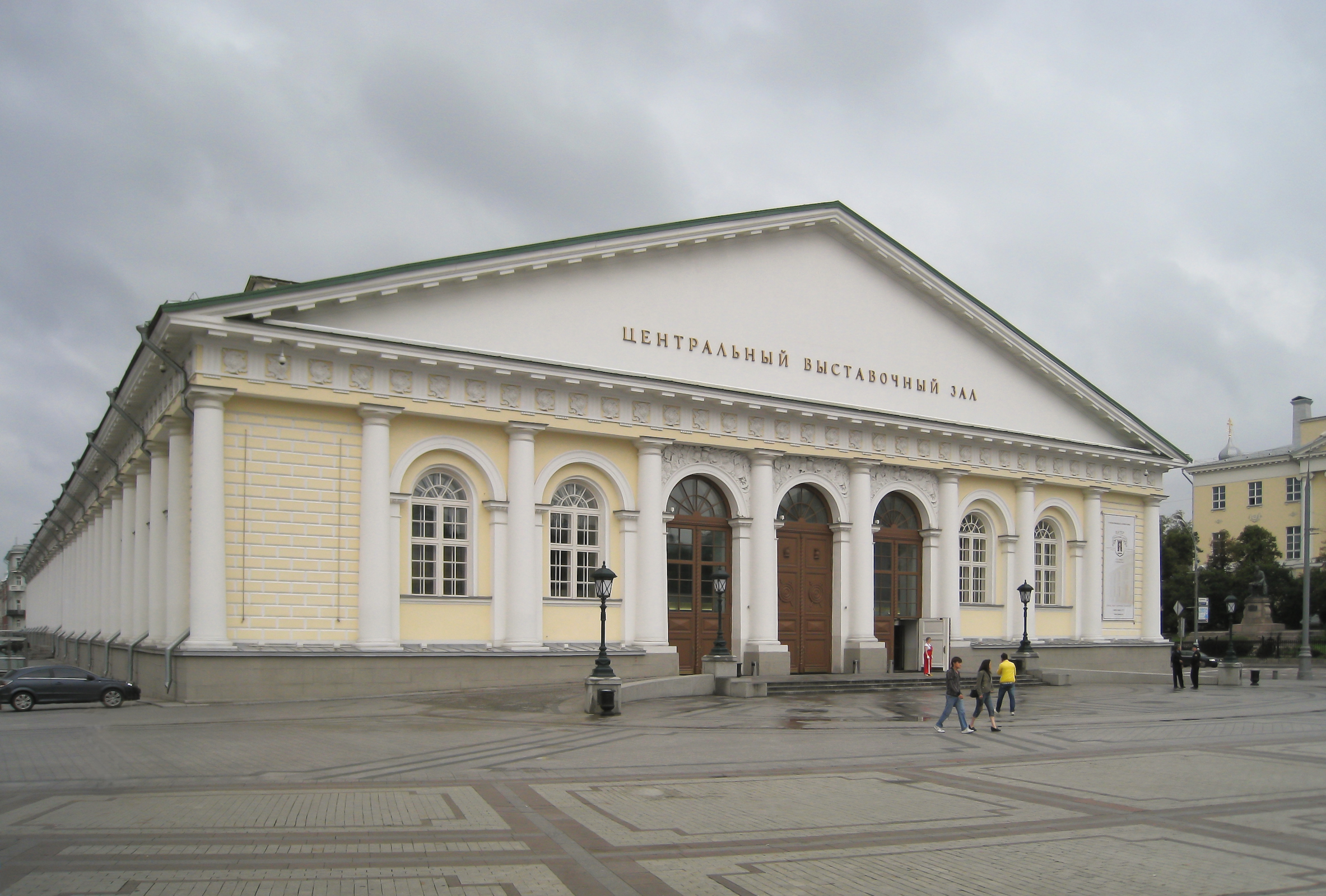
The fair is currently on view through September 21st at the Moscow Manege (pictured above). For visitor information, see http://cosmoscow.com/

Wednesday, June 20, 2012

Jorge Pardo and the 11th Bienal de la Habana

We recently went to Havana with Jorge Pardo for the installation of his new room-sized work in the 11th Bienal de la Habana. Founded in 1984, with the goal of promoting "Third World" art, the Havana Biennial was originally focused on artists from Latin America and the Caribbean, expanding to include Africa and Asia in 1986. In 2009, the organizers decided to invite artists from the US and Europe as well, and the 2012 Biennial was attended by 115 artists from 43 countries.

Wifredo Lam Contemporary Art Center

Held at multiple traditional venues, this year's Biennial also saw performances and interventions spread throughout the streets and squares of the city. The main venue is the Wifredo Lam Contemporary Art Center, named for one of Cuba's most influential artists. Born in 1902, the same year Cuba gained independence from Spain, Lam studied art in Madrid, later fighting in the Spanish Civil War in the 1930's. Afterwards, he moved to France where he fell in with Picasso, Breton and other members of the avant-garde. Returning to Cuba in 1941, Lam re-connected with the traditions of his homeland, fusing elements of Cubism and Surrealism with Afro-Cuban religious imagery. This can be seen in one of his most famous paintings "The Jungle," often compared to Picasso's "Guernica".

The Jungle

Saturday, February 5, 2011

The Gallery: Art Los Angeles Contemporary 2011

This year Art Los Angeles Contemporary (ALAC) was in the Barker Hanger at the Santa Monica Airport, a favored venue for the fair. ALAC is a relatively small-scale and digestible fair which has a very diverse group of galleries from ACE, Los Angeles to Mother's Tank Farm, Dublin. The fair had an independent spirit which we view as one of ALAC's positive attributes.


1301PE's booth at ALAC 2011


Tracy William's booth exhibited three artists, Matt Mullican, Peter Stickbury, and Anna Craycroft, all of whom use portraiture for different means. Many LA artists' space also held booths at the fair. WOR focused on Marnie Weber and Jennifer Bolande. Night Gallery made a day appearance at the Eight Veil booth. The late night Night Gallery experience could not be replicated but the attempt was notable.

Friday, February 4, 2011

Abroad: Peonies considered

There are many obvious advantages to digital substitutes: speed, accessibility, etc... And if digital media can meet or exceed the parameters of human perception what is lost in substituting digital for analog media can be unclear.

LED or RGB digital color is fast and convenient but it is inherently a programmed approximation. The spectrum of color that is visible when light passes through a film membrane reflects the spectrum of light captured during filming. Input reflects output. There is no approximation. Even though our eyes cannot recognize all of the colors in a film, the source of information is true. Digital color is programmed to mimic analog's infinite spectrum of color. Even if digital color is a very good approximation it can never be a true substitute. The digital experience is doubly mediated (first by human perception and second by digital approximation). The correlate analog experience is mediated by only human's physiological limits. It is hard to know what is lost by this secondary mediation but it can often be sensed, if not articulated. The colors in-between the colors we can register are imperceptible but they are there. Perhaps such imperceptible increments, whether they occur in social, aural, or color space, are more vital than we realize.

Thursday, February 3, 2011

Abroad: Diana Thater's Peonies

Diana Thater's exhibition "Chernobyl" opened this past week at Hauser & Wirth in London. "Chernobyl" is an impressive video installation about the nuclear disaster that occurred at the Chernobyl nuclear power plant in Ukraine in 1986. Rather than using editing cuts to convey Chernobyl's landscape Thater opts for film layers, superimposing images on top of one another. In doing this, Thater avoids linear time created by a sequence of images, in favor of time that is sculptural and has depth.


In an adjacent room is Thater's video installation "Peonies." As with "Chernobyl," "Peonies" also utilizes film layers, depicting 3 ghosted peonies on 9 video monitors. To make the video, Thater used her Standard 8mm film camera, which allows back-winding of film, to shoot a true double exposure of the flowers. The layers in "Peonies" were made with analog materials, as opposed to"Chernobyl," whose layers were made digitally. Regarding "Peonies," Thater states that she wanted to make the viewer aware of the difference between analog and digital techniques. Digital techniques may be analogous but they are never identical to the analog techniques they emulate. For example, digital media is pixelated and has only a finite number of colors. Analog media, on the other hand, provides an infinite spectrum of colors - many of which the eye cannot register.


To hear Diana Thater talk about "Chernobyl" and "Peonies" click here.

Saturday, December 4, 2010

The Gallery: Ephemera

The word ephemora is derived from the Greek word ephemeros - meaning lasting for only a day. Therefore, the archiving of ephemora is by definition a contradiction. 1301PE's current exhibition of over forty years of posters designed by John Baldessari is an exemplary showcase of archived ephemora. It also poses an interesting question - how does something expendable turn into something expensive? - how does something valueless turn into something valuable?

Ephemera collage from The Ephemera Society of America

On Michele Behan's list of "The Top Ten Reasons to Profit from Ephemora (In a Tough Economy)", she states that paper collectables are perceived to hold their value better than paper dollars due to incendiary inflation which started in the 1970s. The worth of ephemera is related to many factors - its condition, its completeness if part of a set, etc.... However, the most important of these factors is the legacy of the event to which the material is tied. If the reputation of the event and associated persons increases over time, the worth of the ephemera will increase as well. Unfortunately, this is the one factor that is also far beyond individual control. Nevertheless, a keen eye and sense of history can give a person predictive powers. Either way, a return - even if it is minimal or only sentimental - is almost always guaranteed, as ephemera costs nothing to own and little to store.

Wednesday, November 24, 2010

Food/Wine: The Savory Pie

Almost all Americans are familiar with the sweet pies whether it is filled with cherries, pecans, or pumpkin purée. Plastica on 3rd St, a few blocks away from the gallery, recently hosted a pop-up pie shop. The pies were supplied by I Heart Pies, a husband and wife team who are currently taking online orders only. In addition to selling standard size pumpkin pies and apple crisps, I Heart Pies makes mini pies which are about as filling as a cupcake. One of their most celebrated mini pies is the Peanut Butter S'more Pie which was featured in LA Weekly's Best of Artisanal LA.


Pop-up pie shop at Plastica


Peanut Butter S'more mini pie from I Heart Pies


The S'more pie is decadent and toothsome, as one would expect. Significantly less Americans have experienced the equally diverse and delicious array of savory pies. However, I Heart Pies also has a variety of savory pies - filled with ratatouille, shredded pork, curried chicken, etc... - that also come in mini sizes.

Meat pies are a bit of a novelty in California, but in countries such as Britain, New Zealand or Australia meat pies near ubiquity. In New Zealand meat pies range from the dirt cheap to the gourmet. They are available at nearly all gas stations and convenience stores, making for a guilty yet dependable late night food stuff. There are many notable bakeries in New Zealand that sell meat pies, such as The Fridge in Kingsland. The Fridge has won many awards and their beef and Guinness pie is lauded all over the internet.

The Fridge in Kingsland with neon meat pie sign.

Saturday, November 13, 2010

Archive: Venice, CA Part Two

Venice Part Two 1951-Present

Venice's forlorn condition in the 50s made it an attractive home for many of the early beat poets. Poets like Tony Scibella hung around the Gas House and Venice West Cafe.

Feel of rain in the face
moonjuice/
partial to poets
the lady’s tears
-Tony Scibella

Gas House on Ocean Front Walk


Venice West Cafe
In the 60s, the Venice art scene replaced the 50s Beat scene. Artists involved include Ed Moses, Ed Ruscha, and Billy Al Bengston, dubbed 'The Venice Boys.' According to the website 'Virtual Venice,' Andy Warhol was lured to Venice by Dennis Hopper, and had his first US show in 1962 at the Ferus Gallery which though on La Cienega, had its origins in Venice. In early 60s, hung out with Gavin Lambert who wrote 2 books that concerned Venice. In 1978 Warhol had a show "Torsos" at the Ace Gallery. Owner Doug Chrismas said "When we got to the gallery, the entire street was a solid block of people." To help protect Warhol, he had bodyguards from Gold’s Gym. After the opening, they partied at Hal’s on the beach.

Thursday, November 4, 2010

Archive: Venice, California Part 1

1301PE has been spending some time at John Baldessari's new studio in Venice in preparation for the upcoming exhibition "Not Prints: Posters 1966-2010". For the exhibition the gallery will be covered wall-to-wall with over forty years of posters designed by the artist. These posters mirror the evolution of Baldessari's work which has become more colorful and dimensional over the years. Spending time in Venice, CA, a sub-city in Los Angeles, it is interesting to think about its history over the past 105 years.
Inside John Baldessari's Studio


Poster for John Baldessari "Not Prints: Posters 1966-2010."

Friday, October 29, 2010

Los Angeles: Blinky Palermo & William Eggleston at LACMA

This past Thursday exhibitions featuring work by Blinky Palermo & William Eggleston opened at LACMA. Although they are two independent exhibitions, the works in them operate similarly. This makes their sharing of BCAM's second floor a fruitful coupling. In a conversation a couple days before the opening Lynne Cooke, curator of the Blinky Palermo exhibition, and artist Mathias Poledna spent much time discussing the lightness of Palermo's work. Mathias noted that Gerhard Richter, a friend of Palermo's, was jealous of Palermo's light touch and skill with color. Lynne expanded on this, stating that although Palermo's work seems effortless he struggled and destroyed many paintings he felt to be beneath his standards. His work embodies the effort of looking effortless. This quality also exists in Eggleston's work. His photographs may appear as though they could be taken by anyone but very few people could take the same modest photograph and have it look as successful and effortless as Eggleston. Eggleston, like Palermo, is also a master of color. He was one of the first photographers to use color photography, earning him the title the 'Father of Color Photography.'


Palermo, To the People of New York City, 1976, 40 individual panels, acrylic on aluminum installed at Dia on 22nd St. NYC, 1987-88.

Saturday, October 16, 2010

Abroad: Pae White at The Power Plant

This past weekend Pae White's exhibition Material Mutters opened at The Power Plant in Toronto. The exhibition focused primarily on White's tapestries, although it also included an impressive grid of White's Smoke Carvings and two video works. At the 2010 Whitney Biennial, White exhibited a large smoke tapestry but as this exhibition demonstrates, White's tapestries range greatly in terms of content and style. The smoke and foil tapestries are fairly straight forward in terms of imagery, but the viewer gets lost in all the intricacies. Others are highly collaged and manipulated, full of personal references as well as meta-references to other tapestries made by White.


The Power Plant's signature smoke stack.


30 Smoke Carvings


Some of White's more collaged tapestries

Thursday, October 14, 2010

Abroad: Ryongyon Farm Rehabilitation Program

Ryongyon Farm is one of Dr. Pilju Kim Joo's agricultural rehabilitation programs in North Korea. Dr. Pilju is working with the North Korean government to build a farm that is sustainable. Ryongyon Farm aims to support not only sustainable crops but sustainable lives for its tenants. In addition to having a school for children, Ryongyon Farm supplies food and housing for its workers. The farm embodies the local food movement in many ways that are superior to many American businesses promoting a local food ethos.


cotton fields


Dr. Pilju Kim Joo

Thursday, September 30, 2010

Abroad: Beijing and Pyongyang

This is the first part of an eight part post covering Brian's travels to Beijing, China and Pyongyang, North Korea. Brian was part of a six person group that accompanied Eungie Joo, New Museum's Head of Education and Public Programming, through Beijing to Pyongyang. The group spent five days in Pyongyang, one day in Kosong, and one day in Mount Paektu (the birth place of Kim Jong-Il) with Eungie and her mother, Dr. Pilju Kim Joo, founder and president of Agglobe Services International Inc. These experiences foster curiosity as well as criticism, not only of China and North Korea but also of America, all of which carry serious flaw and merits. Rather than being chronological, the posts documenting this trip will be focused on eight specific topics. Topics include: Dr. Joo's Farm, Food, Murals, Monuments, DPRK Architecture, and the Mass Games. For this first post we introduce the group:


From left to right: New Museum curator Eungie Joo, artist Byron Kim, Dr. Pilju Kim Joo, Hu Fang and Zhang Wei Wei of Vitamin Creative Space, sound artist Tarek Atoui, Brian Butler of 1301PE, & actress Kate Butler.

Saturday, September 18, 2010

Archive: Page Museum at the La Brea Tar Pits

A few blocks down from 1301PE are the famous La Brea Tar Pits and George C. Page Museum. Hancock park was formed around the La Brea Tar Pits and in many ways the Tar Pits are the heart of urban Los Angeles. The first written records of the tar pits were made by Father Juan Crespi during an expedition led by Spanish explorer Gasper de Portoláin 1769. "La Brea" is spanish for 'tar' or 'asphalt.'


Image of the tar pits from 1910 with oil derricks in background.


Wednesday, September 15, 2010

Los Angeles: Bergman, Tarkovsky, and Film at LACMA

LACMA's film department is currently screening "Cries and Whispers: The Psychological Cinema of Ingmar Bergman." Films being exhibited include "The Silence" (1963) and "The Seventh Seal" (1956), the former about contemporary alienation and the latter about a medieval plague. Although renown as a director of dramas, Bergman's films transverse genres, moving from the austere to the comedic to the libidinous. Not surprisingly, Woody Allen described him as "probably the greatest film artist...since the invention of the motion camera."
Bergman and actress Ingrid Thulin during the production of "The Silence"

Early this year LACMA's Film Department held a retrospective of
Andrei Tarkovsky, a Russian filmmaker whose film "My Name is Ivan" (1962) was central to Kirsten Everberg's 2008 exhibition at 1301PE. "My Name is Ivan" is about a 12-year old boy who works as a spy on the eastern front during WWII. Ivan's small stature allows him to cross the Soviet/German border unnoticed, traveling through marsh, barb wire, and the Dnepr River.


Title screen for "My Name is Ivan" (translates as Ivan's Childhood)

Saturday, September 11, 2010

Archive: Two Notable 1301PE Group Exhibitions

In addition to the recent One Room, One Work exhibition, other notable group exhibitions at 1301PE include 'Together Again Like Never Before: The Poster Work of Michael Asher and Martin Kippenberger' from 1999 and Lincoln Tobier, Jorge Pardo, Sarah Seager, and Rirkrit Tiravanija from 1993.

In keeping with his penchant for peripheral spaces, Michael Asher presented only one poster for the exhibition which was the exhibition's invitation. All framed posters inside the gallery space were by Martin Kippenberger, ranging in date from 1978 to 1997.


Installation views


Sampling of some Kippenberger posters

Wednesday, September 8, 2010

Abroad: Angela Bulloch & Christian Dior in Japan

In 2005, Angela Bulloch was commissioned by Dior to create a permanent installation for the Dior flagship store in Osaka, Japan. The installation is titled 'Anroidika Descending The Staircase', referencing Marcel Duchamp's famous painting from 1912 'Nude Descending a Staircase'.

The illuminated cubes change color as the viewer walks down the stairs.


Map of Osaka

Saturday, September 4, 2010

The Gallery & Los Angeles: Behind the Scenes - Diana Thater catalogue and National Wushu Training Center II

Now available at RAM Publications and 1301PE is Diana Thater's catalogue Between Science and Magic. The catalogue includes installation images of Diana Thater's "Between Science and Magic" (2010) as well as documentation of the work's production. In addition to an interview between Diana Thater and Pernilla Holmes, there is an essay by Helen Varola following the history of the illustrious trick 'pulling a rabbit out of a hat'. According to Varola's essay, this illusion began with a notorious incident surrounding "the bizarre pregnancy of Mary Toft," a woman who in the early 18th century faked giving birth to rabbits, a deception she even performed for the king of England.


Reversible book jacket for Diana Thater's Between Science and Magic


Installation of "Between Science and Magic" at the Santa Monica Museum of Art